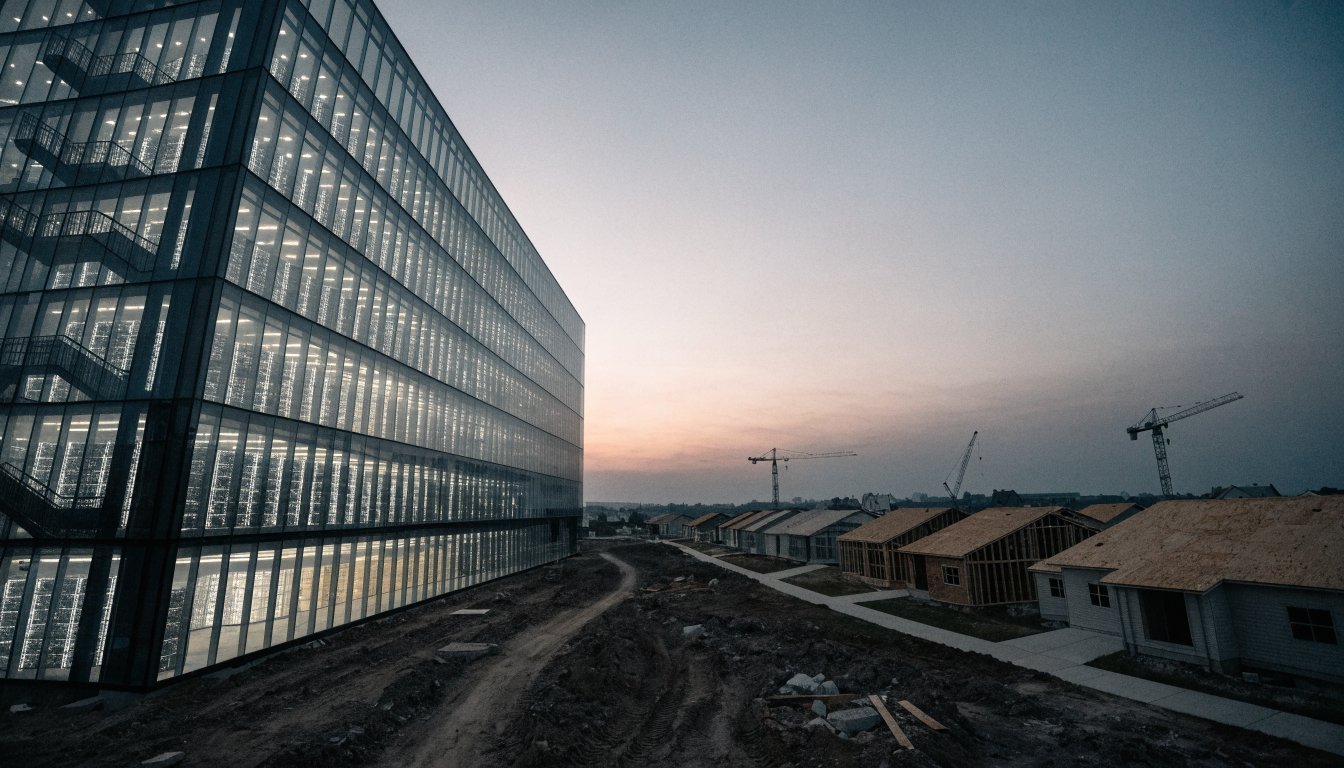
In Texas, a data center developer can outbid a homebuilder for the exact same plot of land, the same electrician crews, and the same grid connection — and it isn’t close. A server farm’s revenue horizon runs decades. A subdivision’s runs one sales cycle. When both are chasing the same acre of land near the same substation, the builder with the longer horizon and the deeper pockets wins almost every time.
That’s not a coincidence playing out in one state. It’s the shape of a story most people are still telling wrong.
The AI boom and the housing crisis are the same story, told from two different rooms.
The usual explanation for why homes are so hard to build and so expensive to buy centers on zoning, mortgage rates, and NIMBYism. All real. But there’s a fourth front that barely gets named: AI infrastructure has become a new, extraordinarily well-capitalized bidder in every market that also needs to build houses. It’s competing for the same land, the same skilled labor, and the same electricity — and unlike a homebuyer, it doesn’t need a mortgage, doesn’t need to live anywhere, and never has to sleep.
The money behind it
The scale here is easy to understate until you see the numbers side by side.
| Metric | Figure |
|---|---|
| U.S. data center construction spend (this year) | ~$700B, up 81% year-over-year |
| Power draw of a single AI training facility | 100–500 MW — comparable to a small city |
| U.S. data center electricity demand, 2025 → 2028 | ~80 GW → ~150 GW (nearly doubling) |
That last figure is the one worth sitting with. Nearly doubling the electricity demand of an entire industry in three years doesn’t happen quietly — it happens by pulling grid capacity, land, and labor away from whatever else was going to use them. In a lot of fast-growing metro areas, “whatever else” is housing.
Land and labor: the direct competition
This isn’t an abstract macro story. It’s playing out in specific cities, on specific parcels, against specific homebuilders.
- In Dallas, Austin, and Houston, hyperscalers are winning land bids against homebuilders on parcels near existing power infrastructure — the same parcels a builder would want for exactly the same reason.
- A single data center campus can employ 4,000–5,000 construction workers at peak, pulling electricians and other skilled trades off residential projects and onto server farms instead.
- Texas — a state already running one of the country’s worst housing shortfalls — is seeing home construction timelines stretch as a direct result.
An electrician can only be on one job site at a time. When a hyperscaler is paying data-center rates for that crew, the subdivision down the road waits.
The bill shows up at home
Land and labor are the upstream story. The downstream story is the one that shows up in your inbox every month.
| Where | Electricity cost change (5 years) |
|---|---|
| Wholesale prices near some data centers | Up to +267% (wholesale, not retail — see note below) |
| U.S. residential electricity, nationally | +42% |
| Washington, D.C. | +94% |
That 267% figure gets thrown around a lot, and it deserves a caveat: it’s a wholesale price figure, not what shows up on a household retail bill, and PolitiFact’s fact-check on the claim is worth reading directly if you want the full nuance. But even with that caveat stripped out, the retail numbers alone are stark — data centers have already added an estimated $23 billion to what Americans collectively pay for electricity, and some states could see another 57% increase by 2030.
None of that shows up on a “housing crisis” dashboard. It shows up as a bigger number on a utility bill, in a market where data centers are the fastest-growing source of new demand on the grid.
Follow the money
Zoom out to where investment capital is actually going, and the concentration is hard to overstate. U.S. venture capital raised $412.7 billion in the first half of 2026 — and $355.9 billion of it, 86%, went into AI alone. That’s the most extreme sector concentration ever recorded in VC history.
Think about what that means for everything AI isn’t. Nearly every dollar of what gets called “innovation capital” right now is chasing one machine. The capital that might otherwise have diversified into construction technology, modular housing, grid infrastructure for residential growth, or a dozen other adjacent sectors — it isn’t happening, because it’s all pointed at the same target.
The reframe
Zoning reform, mortgage rates, and NIMBYism are real and well-covered constraints on housing supply. But they all assume the main competition for land, labor, and power is other housing, or maybe commercial real estate. That assumption stopped being true.
AI infrastructure is now a bidder in every market that also builds houses, and it has structural advantages no homebuilder can match: a multi-decade revenue horizon instead of a sales cycle, a willingness to pay above market for skilled labor, and zero need for the finished product to be livable by a family. That changes who “wins” a housing market — who gets the land, who gets the crew, who gets the grid connection — long before a single mortgage rate ever moves.
The housing crisis and the AI boom aren’t two separate headlines competing for your attention. They’re upstream and downstream of the same capital, in the same cities, bidding on the same things.
Sources
- HousingWire — Data center growth colliding with housing development
- Tom’s Hardware — AI data center labor bottleneck
- Consumer Reports — AI data centers’ impact on electric bills
- Fortune — Data centers hiked bills $23B
- Fortune — 50%+ utility price increase possible by 2030
- PolitiFact — fact-check on data centers and electricity costs
- BuildFastWithAI — AI VC funding concentration, July 2026