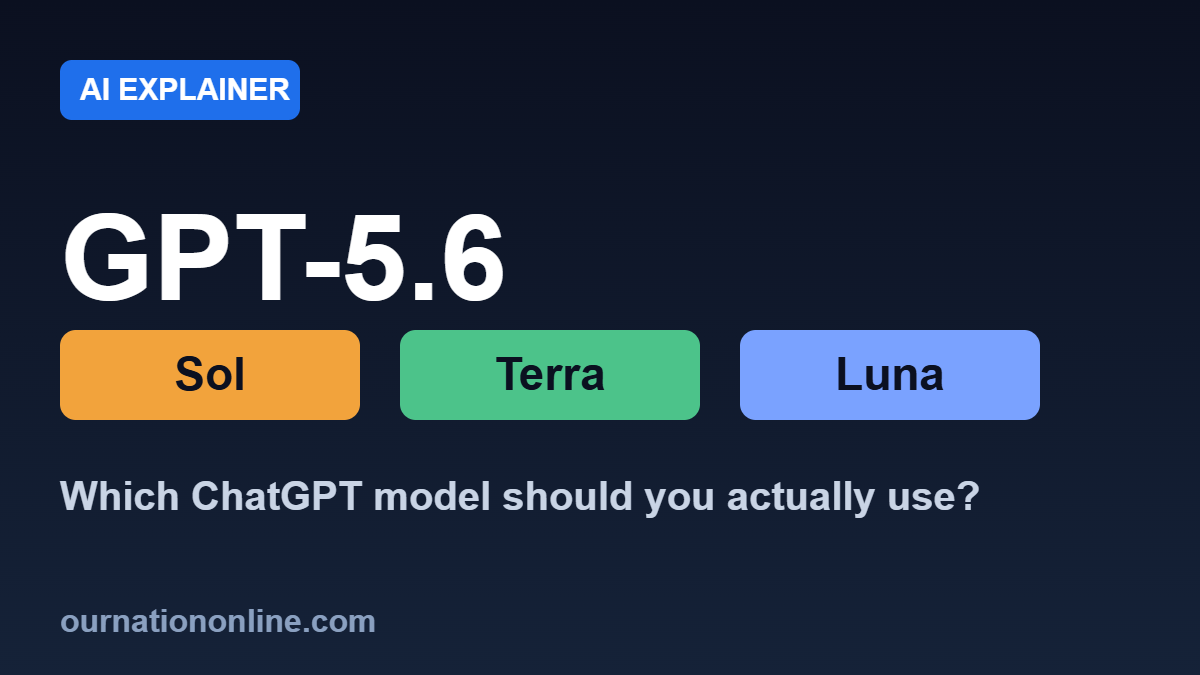
OpenAI just changed ChatGPT again — and this time it isn’t one new model, it’s three. On July 9, 2026, GPT-5.6 rolled out to everyone on a paid plan, arriving as a family of models called Sol, Terra, and Luna. If you opened ChatGPT this week and saw a longer model list than you remember, you’re not imagining it.
So what’s the difference between these three? Which one should you pick for writing an email versus debugging code versus planning a trip? And is any of this actually worth paying for? Here’s a plain-English breakdown of which GPT-5.6 model to use.
Wait — Sol, Terra, Luna? What happened to just “GPT-5”?
For the last couple of years OpenAI kept things simple: one flagship model, one number. GPT-5.6 breaks that pattern on purpose.
The “5.6” tells you the generation. The names — Sol, Terra, and Luna — tell you the tier, or how much power and cost each one carries. Think of it like a car brand releasing the same year’s model in three trims: economy, mid-range, and top-spec. Same underlying engineering, very different price and performance.
Here’s the simple version:
- Sol is the flagship. It’s the smartest, best at hard reasoning, coding, research, and anything that needs deep thinking.
- Terra is the value pick. It performs roughly on par with last generation’s top model (GPT-5.5) but costs a lot less to run.
- Luna is the speed demon. It’s the fastest and cheapest, built for quick, everyday answers.
| Model | Best for | Speed | API price (in / out per 1M tokens) |
|---|---|---|---|
| Sol | Hard reasoning, coding, research, analysis | Slower, most thorough | $5 / $30 |
| Terra | Everyday work, content, production apps | Fast | $2.50 / $15 |
| Luna | Quick replies, summaries, high volume | Fastest | $1 / $6 |
OpenAI’s own framing is that these tiers are “durable” — meaning next year’s upgrade might still be called Sol or Luna, just smarter. So it’s worth learning what each name means now.
Is GPT-5.6 the new “default” in ChatGPT?
This part trips people up, so let’s be precise.
The everyday default for fast replies is still GPT-5.5 Instant — the snappy model that answers most casual questions. GPT-5.6 Sol isn’t replacing that as a blanket default. Instead, Sol now powers the Medium, High, and Extra High reasoning modes on eligible paid plans, and Sol Pro powers the top-tier Pro experience.
In practice, that means when you throw ChatGPT a genuinely hard problem, it can now automatically dial up to Sol-level reasoning to handle it — without you having to fiddle with settings every time.
One important catch: GPT-5.6 is paid-only. It’s available to Plus, Pro, Business, and Enterprise users. If you’re on the free plan or logged out, you won’t see it.
Which model should you actually use?
Here’s a quick guide for real situations:
Reach for Luna when you want speed and volume — drafting quick replies, summarizing a paragraph, brainstorming ideas, simple rewrites. If you’d be annoyed waiting more than a second or two, Luna is your friend.
Reach for Terra when you want solid quality without the flagship price — writing a decent blog post, cleaning up a report, answering moderately tricky questions, or working through everyday tasks where “very good” beats “perfect.”
Reach for Sol when the stakes are high and the problem is hard — debugging a nasty piece of code, working through a research question, analysing data, tackling cybersecurity or scientific problems, or anything where a wrong answer costs you real time. Sol is built for exactly this kind of deep, careful work.
A good mental rule: use the cheapest model that can comfortably do the job. You don’t need a flagship reasoning model to reword a WhatsApp message. If you’re still deciding which assistant to build your workflow around, our take on the best AI apps today is a useful companion read.
What does it cost?
For most people using ChatGPT through the app, this is baked into your Plus or Pro subscription — you’re not paying per message.
But if you’re a developer building on the API, the pricing gap between tiers is huge, and it’s the clearest illustration of why the family exists. Per one million tokens (input/output): Sol is $5 / $30, Terra is $2.50 / $15, and Luna is $1 / $6.
Luna is roughly five times cheaper than Sol. For a business running thousands of requests a day, picking the right tier isn’t a small optimisation — it’s the difference between a manageable bill and a scary one.
Why this matters — especially in India
The three-tier design is really about one thing: matching cost to the task. And that’s great news for the huge number of Indian students, freelancers, small businesses, and developers who care deeply about value.
For a student using ChatGPT to understand a concept, Luna is fast and light — and if you’re revising for exams, pair it with our step-by-step NotebookLM study guide. For a freelancer writing client content, Terra hits the sweet spot. For a startup building an AI product, choosing Luna for simple steps and Sol only for the hard ones can slash costs dramatically while keeping quality where it counts.
It also reflects the bigger 2026 shift in AI, part of the same wave we covered in India’s rise as an AI superpower: the race is no longer only about who has the smartest model. It’s about who lets you use the right amount of intelligence for the right price. Access and cost now matter almost as much as raw capability — and a tiered family is OpenAI’s answer to that.
Frequently asked questions
Is GPT-5.6 free to use?
No. GPT-5.6 (Sol, Terra, and Luna) is available only to ChatGPT Plus, Pro, Business, and Enterprise users. Free-plan and logged-out users don’t get access.
What’s the difference between Sol, Terra, and Luna?
They’re three tiers of the same GPT-5.6 generation. Sol is the most powerful (best for hard reasoning and coding), Terra is the balanced everyday option, and Luna is the fastest and cheapest for quick tasks.
Which GPT-5.6 model is best for coding?
Sol. It’s built for complex reasoning, debugging, and intricate code generation. For lighter code snippets, Terra is usually enough.
Is Sol the new default ChatGPT model?
Not exactly. GPT-5.5 Instant is still the fast default; Sol powers the Medium, High, and Extra High reasoning modes on paid plans.
Which GPT-5.6 model is cheapest?
Luna, at $1 / $6 per million input/output tokens — roughly five times cheaper than Sol.
The bottom line
GPT-5.6 isn’t a single upgrade you switch on — it’s a menu. Luna for speed, Terra for value, Sol for serious thinking. If you’re on a paid ChatGPT plan, the app will often pick a sensible tier for you, but knowing the difference means you’ll never overpay for a simple task or under-power an important one.
The smartest move in 2026 isn’t just using AI — it’s using the right tier of it. Now you know which is which.
Wondering how ChatGPT stacks up against Claude, Gemini, and Perplexity overall, not just tier-to-tier? See our full ChatGPT vs Claude vs Gemini vs Perplexity comparison for the complete pricing breakdown.
Are you using ChatGPT’s new models yet? Which tier fits your workflow best? Let us know in the comments, and subscribe to ournationonline for more plain-English guides to the tools shaping tech.